Machine Learning Corrects Wavefront Errors in Atmospheric Optical Links, Boosting Quantum Encryption Potential
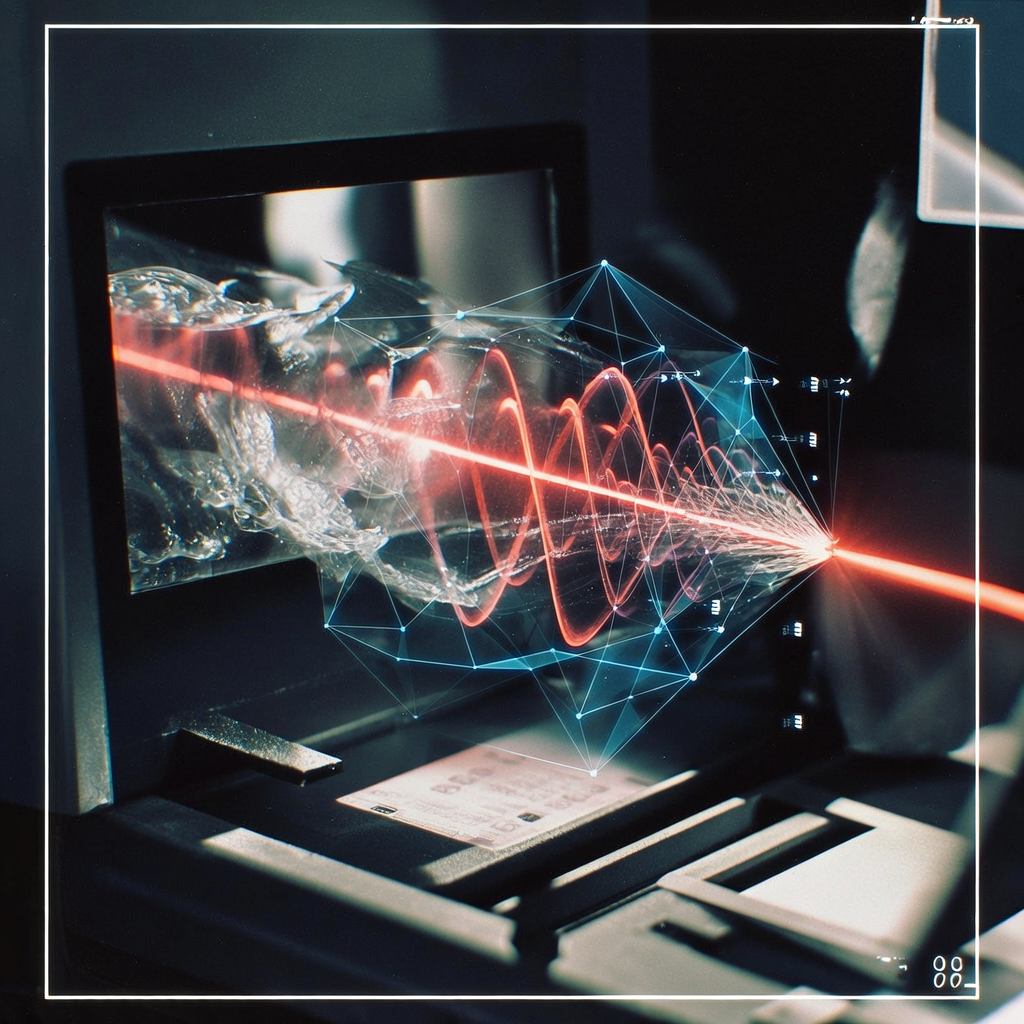
Machine Learning Corrects Wavefront Errors in Atmospheric Optical Links, Boosting Quantum Encryption Potential
In Plain English:
This research solves a problem with sending information through the air using light beams. When light travels through turbulent air over long distances, the light waves get distorted, which can scramble the information. The researchers discovered that the distortion affects different parts of the light beam differently, which previous systems didn't account for. They used artificial intelligence to correct these distortions, making the communication much more reliable. This matters because it could make secure communications - like those used by banks and governments - up to ten times faster while maintaining security.
Summary:
This research challenges the conventional assumption in free-space optical communications that reference beacons and information signals experience identical wavefront distortions when transmitted through atmospheric turbulence. Through experiments conducted over a 2.4 kilometer atmospheric link, the team demonstrated measurable relative wavefront errors between polarization-multiplexed reference beacons and data signals. They developed machine learning algorithms specifically designed for wavefront correction via phase retrieval, achieving up to a two-thirds reduction in relative phase error variance. The implications extend to continuous-variable quantum key distribution (CV-QKD), where correcting these relative wavefront errors could potentially enable an order of magnitude increase in secure key rates for future quantum encryption systems.
Key Points:
- Relative wavefront errors exist between reference beacons and signals in atmospheric optical links, contrary to common assumptions
- Machine learning algorithms can correct these errors through phase retrieval techniques
- Experimental validation was conducted over a 2.4 km free-space optical link
- The correction achieved up to 66.7% reduction in relative phase error variance
- These corrections could enable 10x increases in secure key rates for quantum encryption systems
- Polarization multiplexing was used to separate reference and signal channels
Notable Quotes:
- "In contrast to this assumption, we present experimental evidence of relative wavefront errors between polarization-multiplexed reference beacons and signals, after passing through a 2.4 km atmospheric link."
- "Our findings suggest that if future CV-QKD implementations employ wavefront correction algorithms similar to those reported here, an order of magnitude increase in secure key rates may be forthcoming."
Data Points:
- 2.4 km free-space optical link distance
- Up to 2/3 reduction in relative phase error variance (66.7% improvement)
- Order of magnitude increase potential for secure key rates (10x improvement)
Controversial Claims:
- The claim that relative wavefront errors exist between multiplexed signals challenges the "commonly assumed" equivalence in the field. The assertion that machine learning correction could enable an order of magnitude improvement in quantum key distribution rates represents a strong prediction that would require substantial experimental validation in practical systems.
Technical Terms:
- Wavefront error (WFE), free-space optical link, atmospheric turbulence, polarization multiplexing, reference beacon, phase retrieval, continuous-variable quantum key distribution (CV-QKD), secure key rates, phase error variance
—Ada H. Pemberley
Dispatch from Trigger Phase E0
Published December 5, 2025